Structure and Dynamics of polyelectrolytes and their coacervates

Polyelectrolytes are charged polymers whose counter-ions dissociate in solvent. Many biopolymers (e.g. DNA) are polyelectrolytes and synthetic polyelectrolytes are used in a variety of technological applications (e.g. rheology modifiers). Mixtures of polyelectrolytes of opposite charge can also phase separate, forming a polymer rich coacervate. We study conformations and dynamics of polyelectrolytes and their coacervates utilizing scaling theory and molecular dynamics simulations to predict their structural and mechanical properties.
Dynamics and rheology of nanocomposites
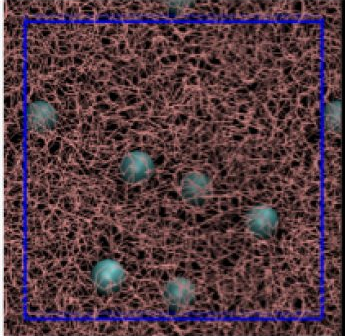
Nanocomposites are mixtures of polymer chains and particles with a size similar to that of the polymer chains (on the order of nanometers). We utilize scaling theory and molecular dynamic simulations to understand non-continuum effects on particle hydrodynamic interactions and their effect on particle dynamics and nanocomposite rheology. This allow us to understand the mechanical properties of nanocomposites with high particle loading.
Aggregation of intrinsically disordered proteins
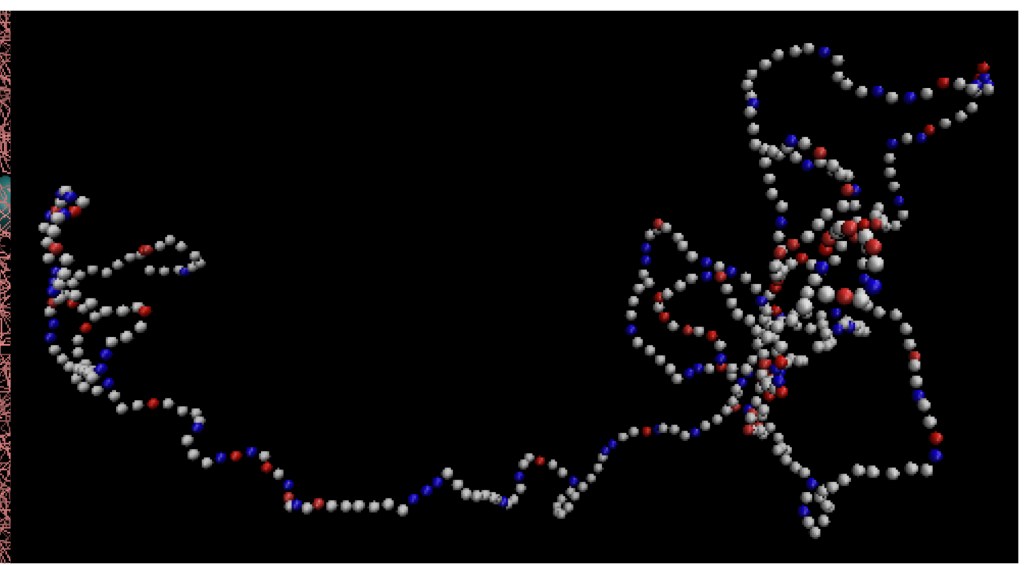
Intrinsically disordered proteins are polymeric proteins that remain “disordered” (unfolded) in their healthy states. Aggregation of these proteins is strongly associated with e.g. neurodegenerative diseases. We use polymer physics to understand the properties and aggregation of these proteins.
Bottlebrush polyelectrolytes for energy applications
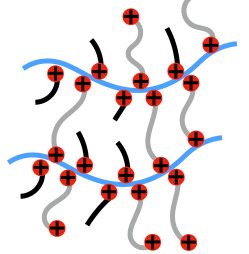
Ion conducting polymers are important for a myriad of applications such as flexible batteries and capacitors. To develop flexible ion conducting polymer systems, we aim to understand how a bottlebrush architecture can be self assembled and used to tune conductive and mechanical properties of the material. To study these materials we use a combination of scaling theory and molecular dynamics simulations.
 Aponte-Rivera Lab